



Icaza Ranked in Latin Lawyer 250 (2027)
03/09/2026
Law 513 of 2026 on Internships: New Regulation
10/09/2026
Scope for Multinational Groups and Passive Income
The Republic of Panama approved Law No. 526 of May 28, 2026, which introduces rules and requirements of economic substance in Panama, applicable only to entities that are members of Multinational Groups that obtain passive income from foreign sources (the “Law”). This law was regulated by Executive Decree No. 32 of September 2, 2026. All these regulations will enter into force as of the 2027 fiscal period.
Below, we answer the most relevant questions for those who maintain Panamanian companies, foundations or trusts regarding the scope of application of this new Law.
1. Scope of the Law
To whom does the Law apply?
It applies to entities (companies, foundations or trusts) that: (i) are members of multinational groups, (ii) have been incorporated or are domiciled in Panama, and (iii) obtain passive income from foreign sources. A multinational group is defined as a group of two or more entities, linked by ownership or control, tax residents in different jurisdictions, including its parent company, its subsidiaries and its permanent establishments.
Panamanian entities are not automatically considered tax residents in Panama just because they have been incorporated in Panama, but when they meet and accredit the requirements established in Article 762-N of the Tax Code. This article defines tax residence in Panama for legal entities incorporated under the laws of Panama that have material means of management and administration within Panamanian territory.
What income is considered passive income from foreign sources?
The Law considers foreign-source passive income to be foreign-source income that comes from:
- Dividends
- Interest
- Royalties
- Capital gains
- Real estate rentals
- Other income from movable capital from foreign sources
Is my company or foundation included under the scope of application of the Law if it does not belong to a multinational group?
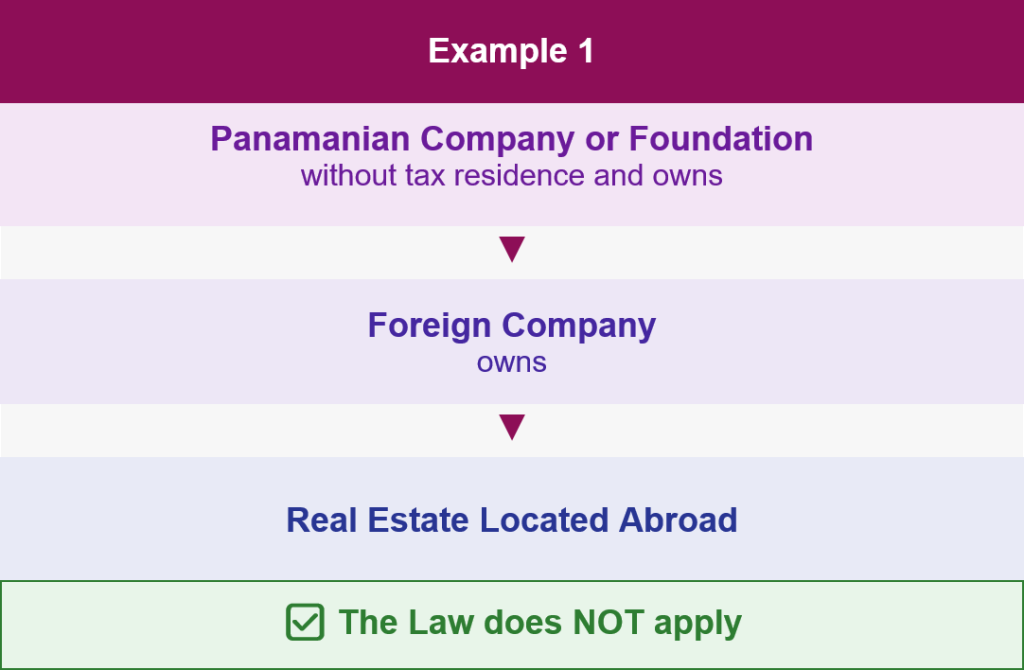
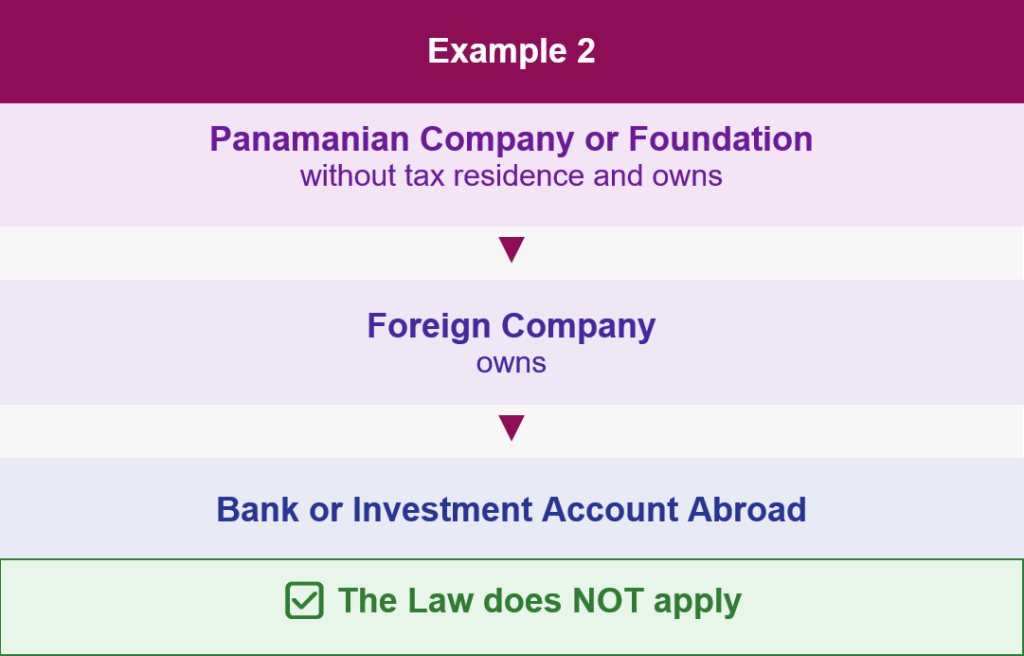
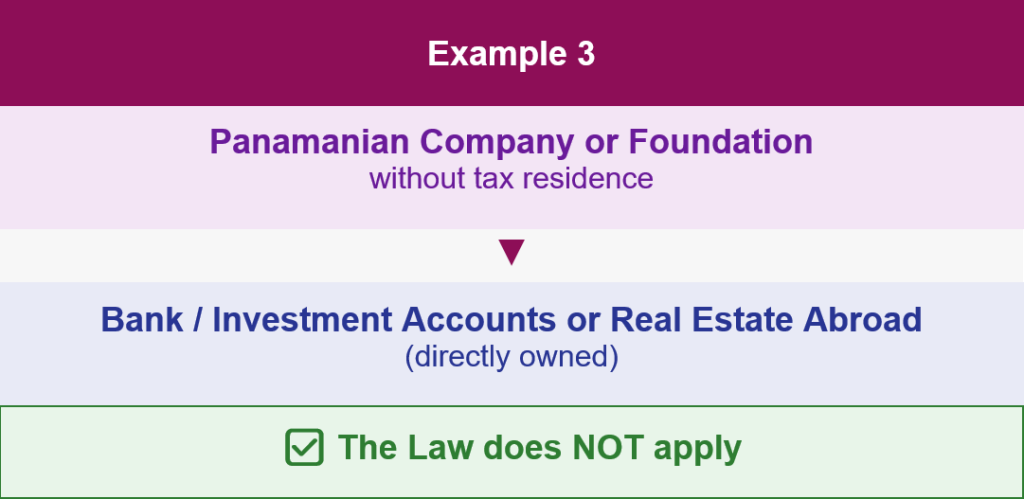
No, even if your entity is Panamanian and receives income from sources in different countries, the Law applies exclusively to entities that are part of a multinational group. If your structure is a Panama company or foundation that operates independently and is not linked to entities in other jurisdictions under common ownership or control or is not part of a group of entities that have tax residence in different jurisdictions, this law does not apply directly to you, regardless of what the sources of income of the Panamanian company or foundation are.
What does “multinational group” mean?
A multinational group is a group of two or more entities or legal persons, linked by ownership or control, who are tax residents in different jurisdictions, including its parent company, subsidiaries and permanent establishments. Although this is not the only applicable criterion, an entity is understood to be part of a multinational group if it is included in the consolidated financial statements of that group or, even if it were excluded from them, should have been included.
The following diagrams illustrate when a structure does (or does not) constitute a multinational group:
It is not a Multinational Group
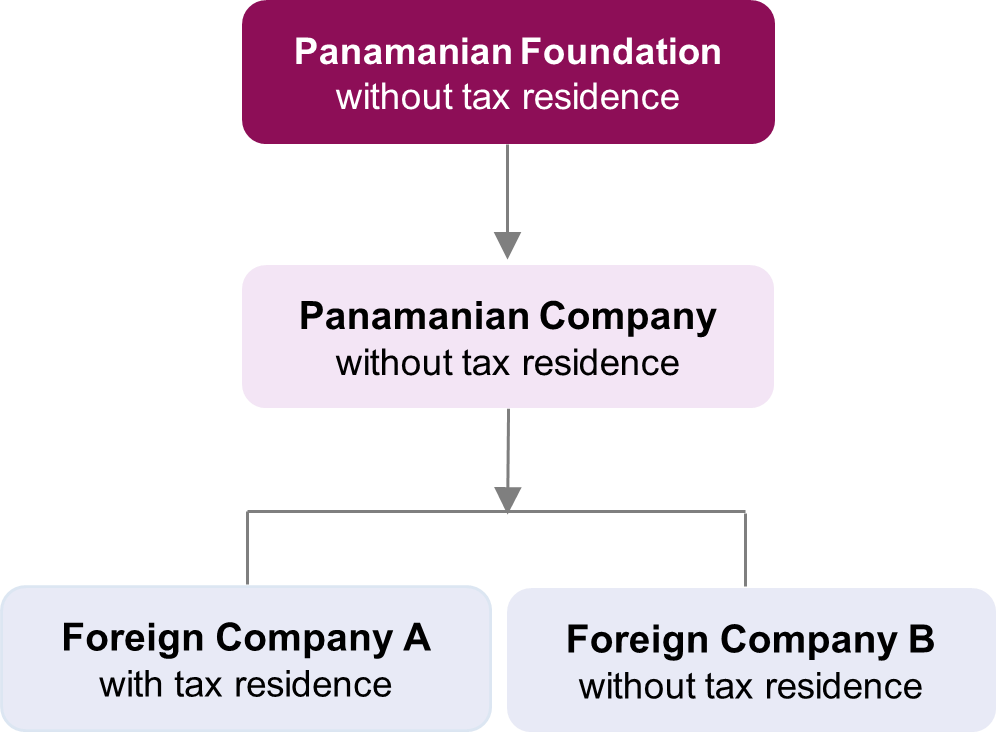
It is a Multinational Group
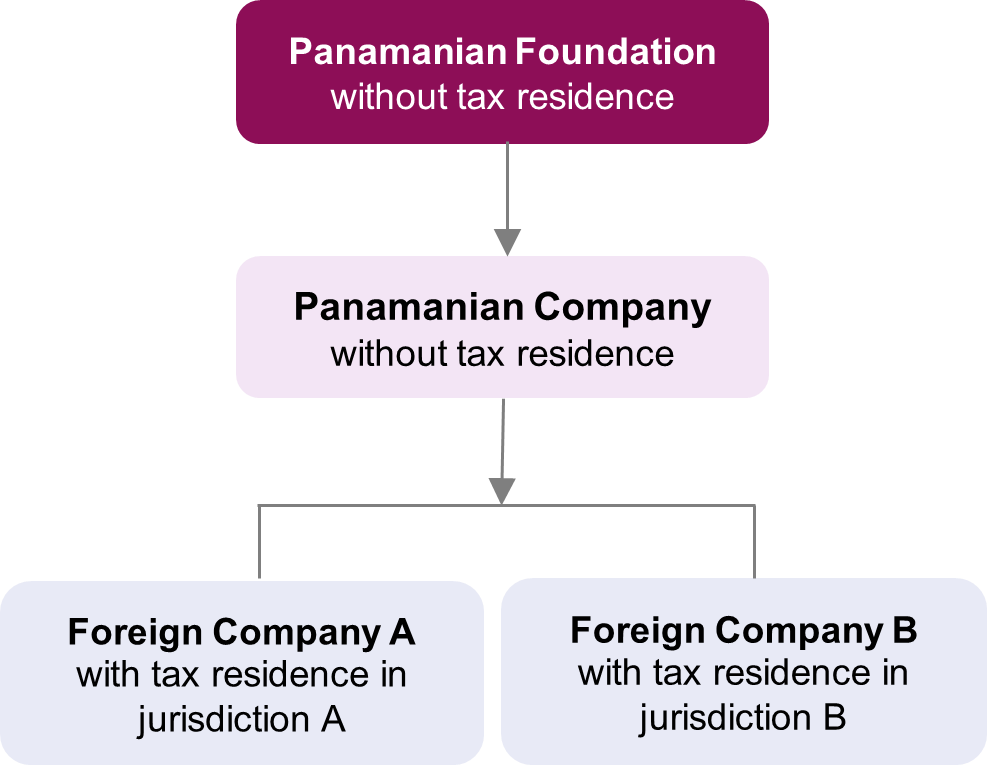
Note: The determination of whether the structure constitutes a multinational group does not change if the Panama Foundation is removed from the previous structures.
Here are some practical examples where the Law does NOT apply:
2. General Principle and Economic Substance
What does it mean that an income is “not taxable” under the principle of territoriality?
Panama applies the principle of territoriality, under which foreign-source income is not subject to Income Tax. For Panamanian entities that are part of a multinational group, the Law maintains that principle, but with one condition: the entity that wishes to take advantage of it must demonstrate that it has real economic substance in Panama.
3. In the event that the law applies to your Panamanian entity due to what is indicated in point 1 of this memorandum, what is required to prove economic substance in Panama?
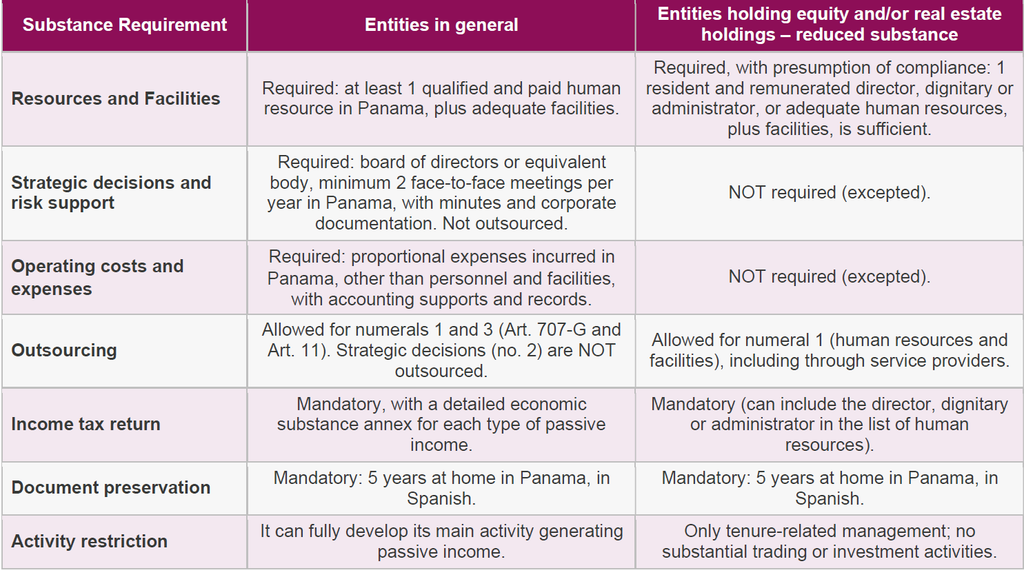
The Regulations of the Law (Executive Decree regulating Law No. 526 of 2026) developed the economic substance conditions provided for in Article 707-E of the Tax Code. For practical purposes, the Regulation establishes two types of economic substance, depending on the main activity of the Panamanian entity that is part of a multinational group: (a) a reduced economic substance for entities holding equity and/or real estate interests; and (b) a complete economic substance for other entities.
What are the general conditions of economic substance?
Article 707-E of the Tax Code establishes three conditions that the Regulations specify in Articles 5, 6 and 7: (1) adequate human resources and facilities; (2) strategic decision-making and risk support; and (3) operating costs and expenses. The requirement of these conditions varies according to the type of entity, as explained below.
(a) REDUCED economic substance for entities holding equity and real estate holdings (Article 8 of the Regulations)
Entities whose main activity is the holding of equity interests in other local or foreign entities (acquisition, conservation and non-habitual disposal), or the acquisition, holding or non-habitual disposal of real estate, enjoy a simplified regime. These entities only have to comply with the first condition (numeral 1 of article 707-E: human resources and adequate facilities), being exempt from the conditions of articles 6 (strategic decisions and risks) and 7 (operating costs and expenses).
For these entities, compliance with the human resources requirement is presumed when at least one of these conditions is met:
- That it has at least one director, dignitary or paid administrator residing in the Republic of Panama and who possesses the appropriate experience or qualifications for the exercise of his functions; or
- That it has adequate and remunerated human resources residing in Panama and with the necessary experience or qualifications for the development of the main activities that generate passive income from foreign sources.
As for the appropriate facilities, they are accredited by physical facilities located in Panama (owned, leased, used or available by any modality, including shared use), proportional and equipped with the necessary resources, duly documented.
Important: these entities can only carry out the procedures inherent to their nature. They would lose the benefit of the reduced regime if they carry out substantial commercial or investment activities, which occurs when: (i) they actively participate in the day-to-day operational decisions of the legal entities in which they hold interests; (ii) they provide financing services to unrelated third parties; or (iii) they carry out regulated financial intermediation activities.
(b) FULL economic substance for the other entities (Articles 4, 5 and 6 of the Regulations)
Entities whose activity is not limited to mere non-habitual patrimonial or real estate holdings must comply with the three substance conditions cumulatively:
- Article 5 – Human resources and facilities: at least one (1) qualified (employee) and remunerated human resource (including through service providers), whose function is directly linked to the management, administration and control of the main activities; and adequate physical facilities in Panama (owned, leased, used or made available by any modality, including shared use), duly documented.
- Article 6 – Strategic Decisions and Risk Support: A board of directors or equivalent body that holds at least two (2) face-to-face meetings per year in Panama, with minutes and corporate documentation. These management functions may NOT be outsourced, delegated or subcontracted. Directors do not have to reside in Panama.
- Article 7 – Operating costs and expenses: incurring proportional costs and expenses in the national territory, other than the remuneration of personnel and facilities, with supports, accounting records, contracts and invoices that prove their link with the main activities.
Can an entity outsource its activities and still comply with the substance?
Yes. Pursuant to Article 707-G of the Tax Code and Article 11 of the Regulations, the requirements of numerals 1 and 3 of Article 707-E (human resources and facilities, and operating costs and expenses) may be outsourced to a service provider in Panama, provided that the activities are effectively executed in the national territory and under the direct supervision and control of the contracting entity. The strategic decisions of Article 6 are NOT outsourceable. In addition, when the provider provides services to more than one entity, the time of the assigned personnel may not be computed simultaneously to accredit the substance of another entity.
In both cases, it will be mandatory to submit to the General Directorate of Revenue the income tax return and the corresponding information, as a mechanism to prove compliance with the conditions of economic substance, in accordance with Article 9 of the Regulations.
Comparison chart of the two types of economic substance
4. Excluded Entities
Are there entities that are outside the regime, even if they are part of a multinational group?
Yes, the following categories are expressly excluded from the regime, subject to the conditions indicated in the Law:
- Regulated banking and financial entities
- Insurers and reinsurers
- Stock market intermediaries
- Investment and pension fund managers
- Entities engaged in the commercial operation of Panamanian-registered vessels or vessels, including shipowners, operators, and ship managers
5. Consequences of Non-Compliance
What happens if my entity does not prove economic substance?
The Panamanian entity belonging to a multinational group will be classified as a “non-qualified entity”. In that case, its passive income from foreign sources will be subject to a single and definitive rate of 15% on the net taxable income of the corresponding tax period.
Are there additional penalties to the 15% tax?
Yes, non-compliance may generate, in addition to the 15% tax, the application of fines, surcharges and interest in accordance with the Panama Tax Code.
What is the Anti-Abuse Clause?
The Ministry of Economy and Finance (MEF) has the power to disregard structures or mechanisms whose main purpose is to obtain tax advantages incompatible with the object of the Law. This implies that purely formal or artificial structures, without real substance, can be ignored in such a way that the relevant Panamanian entity would be subject to the tax that corresponds to a non-qualified entity.
6. Obligation to file income tax returns for entities that are members of a multinational group that obtain passive income from foreign sources
What additional obligation applies to my entity that belongs to a multinational group?
In addition to demonstrating economic substance in Panama, Panamanian entities that are members of a multinational group that obtain income from Panamanian sources and passive income from foreign sources, as well as those that obtain solely and exclusively passive income from foreign sources, will be required to provide annually and within the deadlines established by law, the annual income tax return in order to prove compliance with the conditions of economic substance.
7. Validity and Deadlines
When does this law come into force?
The Law will be applicable to tax periods beginning on or after January 1, 2027. That is, the first income tax return that the Panama entity to which the law applies and must prove economic substance, must be filed within the legal term applicable in 2028, ordinarily in March of that year, unless extended or special ruled.