




Icaza, González-Ruiz & Alemán Recognized in Chambers High Net Worth 2026
27/07/2026
First Case of Sanitary Registration Nullification in Panama
06/08/2026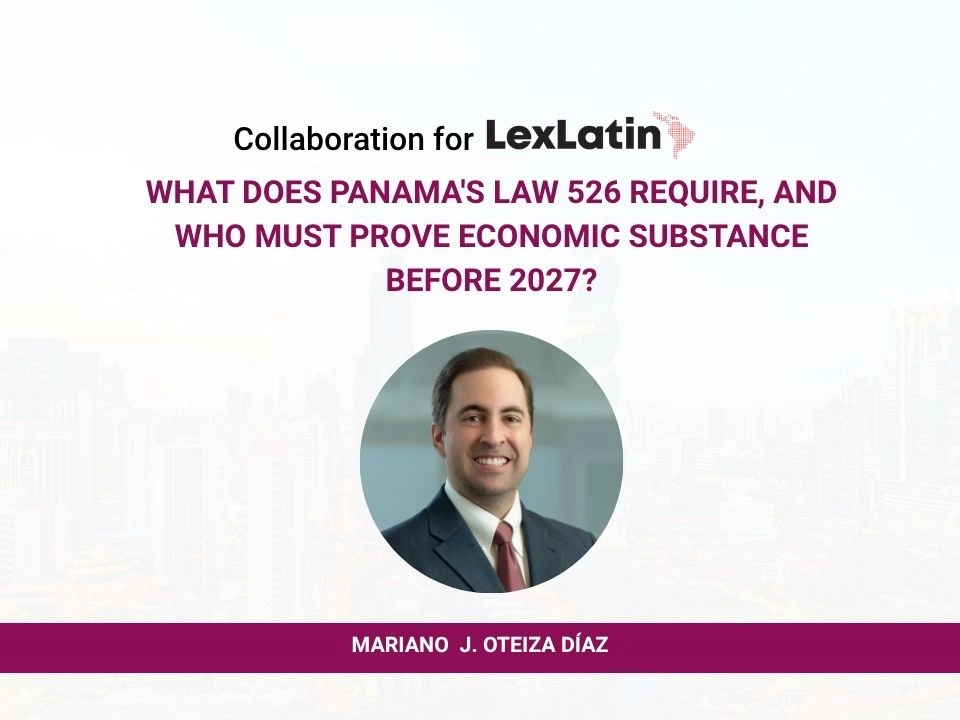
What Does Panama’s Law 526 Require, and Who Must Prove Economic Substance Before 2027?
By: Gunther Felix – Collaboration with Mariano J. Oteiza D. for Lex Latin
A holding company incorporated in Panama that never had an office or employees, and that only receives dividends from a subsidiary in another country, is exactly one of the types of structures targeted by Law 526, which amends the Central American country’s Fiscal Code. That model, used for years in hundreds of wealth and corporate structures registered in Panama, will no longer be sufficient on its own starting in fiscal year 2027, when the new economic substance regime takes effect.
The law, enacted on May 28, 2026 in Official Digital Gazette No. 30534-B, requires Panamanian entities that are part of a multinational group to demonstrate that decisions on that passive income are made in Panama, backed by staff, offices, and operating expenses that support that activity. Those who fail to do so will pay a 15% tax on net foreign-source income.
With less than six months until the new regime takes effect, the regulation that will set out the procedures for proving compliance with the economic substance requirements is still pending. The Ministry of Economy and Finance (MEF) and the Executive Branch have until the end of August to publish it.
In the meantime, banks, investment funds, trusts, shipping companies, and M&A structures that use Panamanian companies still don’t know how they will need to comply with the new obligations.
Who falls within Panama’s Law 526?
The law applies to entities incorporated or domiciled in Panama that are part of a multinational group and obtain dividends, interest, royalties, capital gains, or real estate income from abroad. This means not all Panamanian entities with foreign assets or income are subject to the new regime.
The law defines a multinational group as two or more entities linked by ownership or control that reside in different jurisdictions — including parent companies, subsidiaries, and permanent establishments. If the Panamanian entity is or should be included in its parent company’s consolidated financial statements, it is considered part of the multinational group for purposes of the law.
For Mariano J. Oteiza Díaz, partner at Icaza, González-Ruiz & Alemán, the greatest impact will fall on companies that already had an office, staff, and administration in Panama before the reform.

“The greatest challenge applies to Panamanian entities without current substance in Panama, which, due to their cross-border structure made up of entities from various jurisdictions, must demonstrate that the relevant functions tied to passive foreign-source income are actually carried out from Panama. Law 526 requires adequate human resources, facilities, strategic decision-making, risk management, and operating expenses proportional to the activity carried out. In practice, this forces multinational groups to align the legal form of their structures with a verifiable operational reality,” he states.
The corporate and administrative law specialist explains that the impact will be greater on holding companies, wealth-holding entities, and asset-holding vehicles that for years operated without their own office or employees, since they will have to justify, entity by entity, that they meet the requirements to maintain the tax treatment provided for under the territoriality principle. He also warns that although the law has already been passed, its implementing regulation is still pending.
What is the Ministry of Economy and Finance asking for?
The authority responsible for assessing compliance with economic substance is the Ministry of Economy and Finance, not the General Directorate of Revenue. Before any approach to the MEF, the Icaza, González-Ruiz & Alemán partner recommends preliminary work across three layers.
- Scope diagnosis. Determine whether the Panamanian entity belongs to a group with tax residents in more than one jurisdiction and whether it actually receives any of the passive income covered by the law.
- Documentary matrix. Gather staff contracts, minutes showing that strategic decisions were made in Panama, local operating expense invoices, and evidence of physical facilities available for the operation.
- Annual report. The third layer is resolved once a year, in the income tax return, where the company reports foreign-source passive income along with evidence of substance. Oteiza stresses that the sufficiency of that substance is measured against the real scale and complexity of the activity, the type and amount of the income, the number of assets generating it, and the level of risk assumed by the group in Panama.
Not all structures face the same standard. Entities dedicated exclusively to holding equity interests, and those whose activity is limited to buying, holding, or selling real estate on a non-habitual basis, face a lower threshold — they must show adequate human resources and facilities in Panama, but the law does not require them to demonstrate strategic decision-making or additional operating expenses from the country.
Banking and funds, exempt with conditions
Panama’s financial sector is, in principle, outside the scope of the new regime. The law excludes banks, insurers, reinsurers, securities market intermediaries, and investment and pension fund managers, provided they carry out regulated activities supervised in Panama.
Oteiza maintains that the exclusion requires the entity to hold the corresponding authorization and operate under the supervision of the Superintendency of Banks or the relevant regulatory authority.
The situation is different for trusts. The law does not expressly include them among the parties subject to the regime, but it doesn’t exclude them either. Since a trust lacks its own legal personality, the analysis centers on the trustee and the structure of each transaction.
“In trust structures, what matters will be identifying who the legally relevant entity is, where it is tax resident, which entity receives the passive income, and whether there is a link through ownership or control within a multinational group,” he specifies.
In practice, administrators of Panamanian trusts will need to review each structure before the start of fiscal year 2027, since the law does not provide a general exemption for this type of vehicle.
The maritime exception
The maritime industry follows a different logic than a financial holding company, and Law 526 recognizes this. The law excludes from the regime shipowners, operators, and administrators of Panamanian-flagged vessels engaged in commercial operation, provided they meet the required conditions.
The Icaza, González-Ruiz & Alemán partner explains that a large share of shipping business income is generated in transit or directly outside Panamanian territory, which doesn’t fit the framework designed for purely passive income.
He notes that entities will have to prove they carry out a genuine maritime activity. If a company presents itself as a shipping company but in practice functions as a financial asset-holding vehicle, it will have to demonstrate to the Ministry of Economy and Finance that its classification matches the activity it actually carries out.
For logistics companies operating from Panama, Oteiza notes that they normally already have staff, offices, and decision-making capacity in the country as part of their business. The analysis becomes relevant when a Panamanian entity provides logistics services abroad, since it will be necessary to determine whether it is part of a multinational group and whether it earns foreign-source passive income.
The new filter in M&A deals
Panama will remain a jurisdiction used to structure regional M&A transactions, but the new regime adds a new layer of analysis for Panamanian companies acting as acquisition, holding, financing, or exit vehicles.
In Oteiza’s view, beyond assessing the corporate, succession, or tax efficiency of the structure, it will be necessary to determine whether the Panamanian entity will be part of a multinational group and whether it will earn foreign-source passive income, such as dividends, interest, or capital gains. That assessment will establish whether the company falls under the economic substance regime.
“Advisors will need to decide whether the Panamanian entity will carry out real functions of direction, administration, investment control, or risk management from Panama, or whether it’s better to use another jurisdiction or vehicle for certain functions. It will also be important to document from the outset where strategic decisions are made, who manages the assets, where expenses are incurred, and how the Panamanian presence within the structure is justified,” he adds.
Economic substance will also become part of risk analysis in purchase-and-sale transactions, due diligence processes, and regional reorganizations. A Panamanian entity that fails to meet the requirements could become subject to the exceptional 15% tax on foreign-source passive income, plus fines, surcharges, and interest, if the Ministry of Economy and Finance deems it a non-qualifying entity.
The lawyer believes the new regime doesn’t change the use of Panama as a platform for structuring regional transactions, but it does require that the functions assigned to Panamanian companies be backed by sufficient resources, staff, decision-making, and documentation.
Outsourcing, now under scrutiny
The law allows certain core activities to be outsourced, provided the provider actually performs them in Panama and has the staff and facilities needed to deliver the service. For Oteiza, that flexibility doesn’t release companies from their obligations. The Panamanian entity must maintain oversight and control of the delegated activities, while the provider must supply documentation proving the services rendered and the resources used.
The regime also sets limits to prevent the same provider from using the same resources to support the economic substance of multiple clients. When a provider serves multiple entities, it must show that the staff and time allocated to each correspond to services actually rendered, not duplicated resources.
“For companies, outsourcing stops being merely an administrative solution and becomes part of the evidentiary record for economic substance. Service agreements, work reports, invoicing, evidence of assigned staff, facilities used, and oversight mechanisms will be key elements in proving compliance,” he emphasizes.
Is Panama still competitive?
The new regime’s entry into force raises a question for multinational and family groups that use Panamanian companies in their structures: will Panama remain a competitive jurisdiction?
For Oteiza, the answer is yes. The territoriality principle remains in place, and the reform does not alter the advantages that have historically underpinned the country’s appeal as a business center. What changes is that certain entities will need to prove they have economic substance to keep the tax treatment provided under the law.
In that sense, the expert believes Panama is following the trend seen in other jurisdictions, which in recent years have added economic substance requirements for certain corporate vehicles.
“The new regime will likely favor structures with greater substance, governance, and documentation, and will reduce the appeal of purely passive or artificial vehicles whenever they involve links to entities in different jurisdictions. Law 526 can strengthen Panama’s positioning as a serious jurisdiction aligned with transparency standards, provided the regulation is reasonable and allows for practical implementation for legitimate companies, family groups, and international structures,” he highlights.
The Icaza, González-Ruiz & Alemán partner maintains that Panama’s competitiveness will increasingly depend on companies’ ability to back up, with resources, functions, and documentation, the activity they carry out in the country when the law requires it.
For structures that don’t perform a relevant economic, commercial, or wealth-management function in Panama, the recommendation among tax advisors is to weigh two paths: keep the entity and strengthen its local presence, or reorganize it toward a jurisdiction better suited to the group’s wealth and tax objectives.
While the regulation remains pending, entities covered by the new regime can already begin reviewing their structures and assessing whether they meet the requirements that will take effect starting in fiscal year 2027.