



Wealth Planning in Panama: Securing Your Legacy
14/09/2026
What Changed With Decree 17 in Panama?

Por: Ana Graciela Medina – Partner
Panama reaffirms its commitment to legal certainty and foreign investment through Executive Decree No. 17 of September 8, 2026, published in Official Digital Gazette No. 30613 and in effect since September 16, 2026. The regulation updates and consolidates the provisions of the permanent residency program under the Qualified Investor category, with rules on investment modalities, ownership structures, value verification, investment maintenance, and the inclusion of new dependents.
The decree replaces Executive Decree No. 722 of 2020 and its amendments. It also provides that naturalization applications filed by qualified investors must be submitted through the window of the Ministry of Commerce and Industries (MICI), while continuing to comply with the applicable constitutional and legal procedures and requirements. .
For those considering investing in and settling in Panama, these are the program’s main opportunities.
1. Pathways to Permanent Residency
The program allows applicants to request permanent residency through real estate investments, investments in the Panamanian securities market, or fixed-term deposits. The required amount depends on the option chosen.
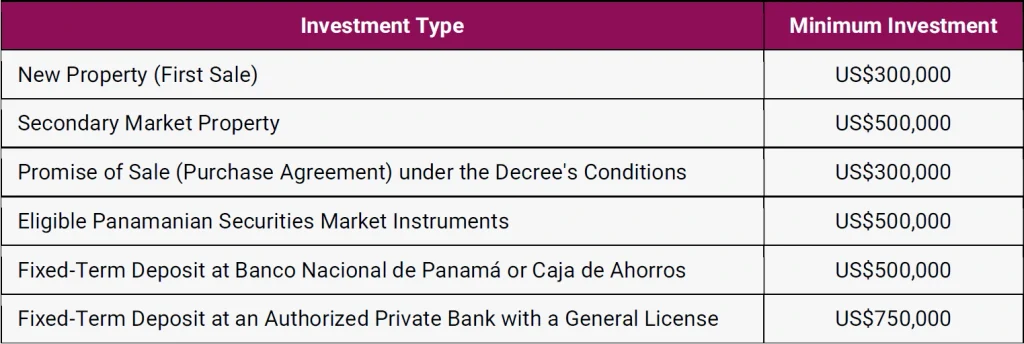
These amounts correspond to the investment itself. Immigration processing fees and other expenses are considered separately.
2. Domestic or Foreign Investment Structures
The investor may act in a personal capacity or through a legal entity duly organized and in good standing under the laws of its jurisdiction. For real estate investments, the decree expressly recognizes both domestic and foreign legal entities and private interest foundations.
This makes it easier to use existing wealth structures, provided that the applicant’s status as ultimate beneficial owner and effective control over the investment are demonstrated, depending on the applicable modality.
This flexibility comes with conditions. The existence and good standing of the entity, its ownership, representation, and control structure must be established, in addition to complying with the specific rules of the chosen investment. Accordingly, the regulation should not be understood as blanket authorization for any type of vehicle.
Funds must belong to the applicant, originate abroad, and have a documented trail. Donations, gifts, or other gratuitous transfers from third parties do not count toward the required minimum. Funds already on deposit in Panama may also be recognized if their origin can be traced to a prior international transfer.
3. New and Resale Properties
For a new, unoccupied property acquired from the developer, promoter, or their successor in interest, and that qualifies as a first sale, the minimum investment is US$300,000. For secondary market properties, the minimum is US$500,000.
The secondary market includes properties that have previously been sold, occupied, leased, or transferred to an unrelated third party, in accordance with the decree’s rules and exceptions. This does not necessarily mean purchasing a “second home” — it refers to the status of the property itself.
In both categories, the computable net value must reach the required minimum. It is calculated by taking the lower of the price actually paid and the reasonably substantiated commercial value, minus the outstanding balance of any liens affecting the property. If the purchase price exceeds the minimum, the excess may be financed, provided the financing is documented and traceable and no lien reduces the computable net value below the required amount.
4. Appraisals for Greater Value Certainty
The decree strengthens value verification for both first-sale and secondary market properties. ANATI’s cadastral certification remains a requirement and is assessed together with the acquisition, payment, and source-of-funds documentation. When the circumstances set out in the regulation arise — such as objective factors raising reasonable doubt about correspondence with market value — the authority may request an independent commercial appraisal.
This mechanism helps prevent overvaluation and confirms that the declared investment is supported by the property’s value. An appraisal is not an automatic requirement for every purchase, nor does it guarantee the price or eliminate the risks of the transaction. It is a supplementary verification element and does not replace proof of payment, the foreign origin of the funds, or their traceability.
When required, the appraisal must have been issued within the six months prior to its submission and be signed by a duly qualified professional recognized by Banco Nacional de Panamá and Caja de Ahorros. The appraiser must meet the independence requirements and substantiate the methodology, comparables, and conclusions of the report.
For example, paying US$550,000 for a secondary market property whose recognized commercial value is US$480,000 does not satisfy the US$500,000 minimum, even in the absence of liens. Investments made through a promise of sale are likewise subject to value verification under Article 7.
5. Eligible Securities Market Instruments
With an aggregate minimum of US$500,000, the program allows for one or more eligible investments made through a brokerage firm licensed by Panama’s Superintendency of the Securities Market. The capital must remain invested for a minimum period of five years from the date it is credited to the account.
Options include private equity and venture capital funds oriented toward productive investment in Panama; debt instruments issued or guaranteed by the Panamanian State; and eligible corporate securities, such as stocks, corporate debt, mutual funds, and real estate investment funds.
This allows investors to choose a single investment or combine instruments within the authorized categories. The products must meet the registration, supervision, and economic-link-to-Panama requirements established by the decree.
The regulation also accounts for market fluctuations: a decline in value beyond the investor’s control does not, by itself, result in a failure to meet the minimum, provided there is no withdrawal, disposal, or voluntary lien, and the amount is restored within 90 calendar days following notification from MICI.
6. Deposits at State Banks Starting at US$500,000
The decree sets a threshold of US$500,000 for fixed-term deposits placed directly and exclusively with Banco Nacional de Panamá or Caja de Ahorros, both state-owned banks.
At private banks holding a general license authorized to operate in Panama, the minimum is US$750,000.
In both cases, the deposit must be maintained for a minimum of five uninterrupted years and remain free of the liens, third-party financing holds, and pledges identified in the regulation. The foreign origin of the funds must be substantiated in accordance with the banking conditions of Article 9, which contemplates international SWIFT transfers from accounts held by the applicant or through a legal entity of which the applicant is the ultimate beneficial owner.
7. Flexibility to Change the Investment
The obligation to maintain the investment does not prevent replacing it with another investment that meets the program’s requirements.
If the investment ceases, is sold, is replaced, or otherwise ceases to exist before completing the minimum five-year period, the resident must notify MICI within 30 calendar days of the event. The Ministry will grant a period of up to 90 calendar days to document an equivalent reinvestment, in accordance with the decree. These are separate obligations with separate deadlines.
During that period, any administrative action aimed at canceling residency on this basis is suspended. If the substitution or reinvestment is not completed, the regulation provides for cancellation of the permit.
This option allows investors to reorganize their assets, provided the corresponding amounts, conditions, and deadlines are respected.
8. Protection for Under-Construction Projects
Residency may also be based on a promise of sale starting at US$300,000, either through a deposit held in trust administered by a bank or trust company licensed to operate in Panama, or through payment of 100% of the property’s value to the developer or promising seller, under the conditions of Article 7.
Under the 100% payment-to-developer modality, when the property has not yet been built or has not been subdivided or registered, a banking instrument in favor of the investor is required, issued by an entity licensed to operate in Panama. It must be irrevocable, unconditional, and payable on first demand; cover at least the full amount of the investment; and remain in force until the property is built, subdivided, and registered in the investor’s name. It may take the form of a standby letter of credit, an irrevocable bank guarantee, or a bank performance bond. This specific safeguard should not be confused with the trust-deposit modality.
Under both sub-modalities, if the promise of sale fails to be completed due to a breach attributable to the developer or promising seller, the decree provides a special 180-business-day period to substitute the investment, counted from the business day following expiration of the agreed term. Substitution through another promise of sale may only be exercised once. In addition, the cumulative time of immigration status based solely on promises of sale may not exceed three years, whether continuous or non-continuous. Failure to comply with these limits may result in cancellation of the permit.
9. New Dependents After Obtaining Residency
Article 17 allows for the subsequent inclusion of new children by birth or adoption, and a new spouse through a civil marriage entered into after residency has been approved.
The investor must keep their residency in good standing and comply with the investment maintenance conditions. They must prove this status through MICI certification, document the new family relationship, submit a letter of economic responsibility and the other required documents, and pay US$1,000 to the National Treasury and US$1,000 to the National Immigration Service for each new dependent. Upon completion of the process, the dependent receives their permanent residency card.
This provision allows the program to accommodate changes in family life. Its specific scope covers these relationships arising after the principal approval.
10. Naturalization Applications Through the MICI Window
Article 14 provides that naturalization applications from permanent residents under the Qualified Investor category must be submitted through the window of MICI’s National Investment Directorate, the entity involved in administering the program.
For this process, MICI will issue a certification addressed to the National Immigration Service confirming that the investment remains valid and meets the required parameters. The certification must identify the nature and amount of the investment, as well as the details of the holder or ultimate beneficial owner.
This article applies to qualified investors and their dependents who have completed five consecutive years of residency in Panama, in accordance with the Constitution. The ability to apply for naturalization remains subject to the applicable constitutional and legal procedures and requirements.
The scope of this provision is administrative: it channels the filing of applications through the MICI window and incorporates the investment certification. It does not create an accelerated or automatic path to Panamanian nationality, does not reduce the applicable requirements, and does not guarantee approval merely because an investment was made or five years of residency were completed.
11. Clearer Procedures and Deadlines
The decree establishes a special processing window and sets a deadline of up to 15 business days to issue the investment certification, counted from admission of the complete file, and up to 30 business days to resolve the residency application from formal receipt of the complete file, without prejudice to any legally applicable suspensions. These deadlines have specific starting points and do not constitute a special deadline for resolving naturalization applications.
The application may be filed through legal counsel before the investor and their dependents enter Panama. To obtain the immigration card, they must first complete biometric enrollment and the corresponding registration.
The investment must be maintained for a minimum of five years and verified annually with MICI, through the resident’s legal representative. The documentation must be submitted within the 30 calendar days preceding the anniversary of the immigration resolution.
12. Transition Rules for Prior Applications and Investments
Applications filed before the decree’s effective date are governed by the requirements, conditions, and amounts in force at the time of filing, without prejudice to any more favorable procedural rules. Separately, investments and binding contracts perfected before that date may qualify under the prior regime if the application is filed within six months of the effective date. Previously issued investment certifications remain valid until their expiration.
Article 19 also prohibits the retroactive application of the new appraisal and verification rules to disregard previously certified investments, except where there are objective indications of falsity, simulation, fraud, or unlawful origin of funds, and always subject to due process.
Those who, at the time the decree takes effect, have pending applications or valid status under the former “own economic solvency” category have twelve months to request conversion to the Qualified Investor category, provided they meet the applicable amounts and other requirements. Investments made before October 15, 2020 are not eligible for this conversion.
The new decree offers a clearer framework for structuring investment and planning permanent residency in Panama. Its value to the investor lies in understanding the available options, the required documentation, and the obligations that accompany their immigration status.
Advice for Planning Your Investment and Residency
At Icaza, González-Ruiz & Alemán, we support investors in evaluating these alternatives and preparing their applications, taking into account their wealth structure, objectives, and family situation. Legal certainty is strengthened through clear rules and informed planning tailored to each case. Contact us bd@icazalaw.com.
This article is for informational purposes only and does not replace a case-by-case legal assessment.